

The current IOC consensus statement describes problematic low energy availability (LEA) as the primary driver of Relative Energy Deficiency in Sport (REDs). The critical factor is how much energy remains for the body's physiological functions after accounting for exercise expenditure. Consequently, the syndrome affects not only menstruation or bone health but numerous systems - including metabolism, the endocrine system, bone, immune function, hematology, and mental health.
It’s not just about total energy—we are increasingly recognizing how crucial carbohydrates are.
REDs is often associated with very low body weight, the absence of a menstrual period, or extreme training habits. However, the picture today is much more nuanced. The body can react to insufficient energy intake long before such obvious signs appear. Furthermore, new research shows that in addition to energy availability , carbohydrate availability can also play a significant role.
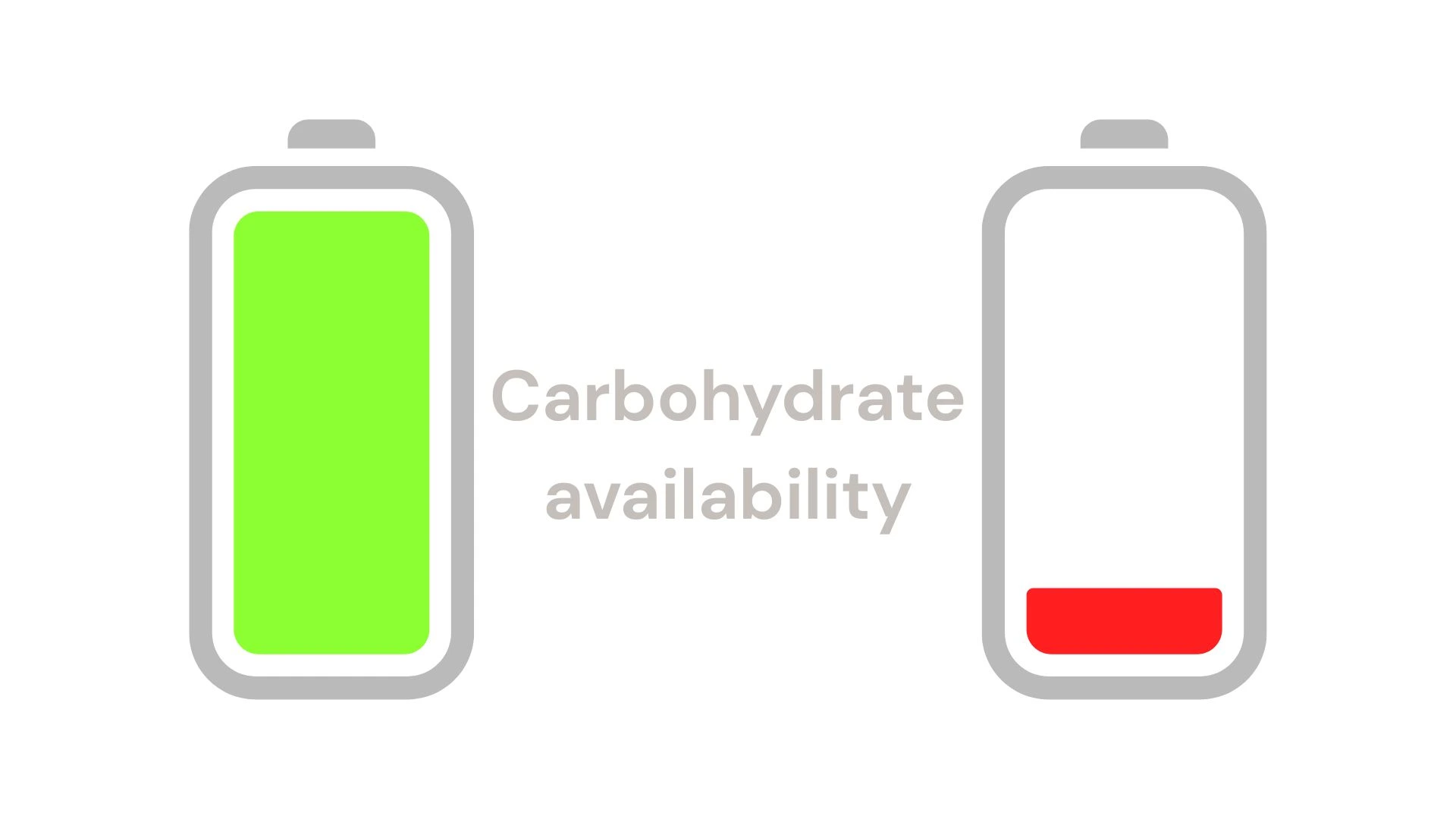
Carbohydrate availability refers to the amount of carbohydrate fuel actually available to the body. It is determined by the glycogen stored in the muscles and liver, as well as carbohydrate intake before and during training.
Low carbohydrate availability can alter certain metabolic processes (in bones, muscles, etc.). Interestingly, such changes have also been observed even when total energy intake was sufficient. This does not mean that a low-carbohydrate diet is automatically problematic - the key factors are duration, training load, and overall energy supply.
A complex interplay
REDs cannot be reduced to a single symptom, lab value, or body weight. Rather, it is a complex interplay of various bodily adaptations to long-term insufficient intake. Energy availability, carbohydrate availability, hormonal regulation, and body composition are all interconnected. Current research findings increasingly show that the body can react very sensitively to inadequate supply - often long before these changes become externally visible.
Carbohydrates and hormones—perhaps an underestimated connection
New findings regarding hormonal changes during low energy and carbohydrate availability are particularly interesting. Under conditions of low energy availability, the presence of low carbohydrate availability led to more pronounced changes in certain hormonal markers. After just four days of low carbohydrate availability , muscle glycogen stores dropped significantly, while various metabolic markers shifted. Of particular interest: IGF-1 decreased and a marker for bone resorption increased, even though overall energy availability was sufficient. Higher carbohydrate availability was able to partially mitigate some of these changes. This makes it increasingly clear that it is not just the total amount of energy, but also the availability of carbohydrates that can be relevant for hormonal regulation .
REDs doesn't always show up on the scale.
Another important topic is body composition. REDs does not automatically mean weight loss or a very low body fat percentage. Current data show that inadequate energy supply can be linked to changes in various components of body composition – including muscle mass, bone, and adipose tissue. At the same time, body weight can remain relatively stable. The number on the scale therefore tells only a small part of the story. A supposedly "normal" or unchanged body composition does not, therefore, rule out REDs.
It remains an exciting field
The latest research findings regarding carbohydrate availability are particularly interesting. Data suggest that it may play an independent or reinforcing role in LEA . These two factors can overlap and reinforce each otherThere are still many unanswered questions, but new research projects will reveal the full extent of the role carbohydrate availability plays. For now, the goal should be to aim for sufficient carbohydrate intake. This does not mean that fasted training or training with periodized intake is generally discouraged. However, based on these new findings, one should ensure a generally adequate carbohydrate intake to prevent negative effects.
Further reading:
Godley et al. (2026). Relative Energy Deficiency in Sport (REDs) and Body Composition. Sports (Basel, Switzerland), 14(8), 314. https://doi.org/10.3390/sports14080314.
Mosquera-Lopez et al. (2026). Low Carbohydrate Availability in Energy Balance Alters Bone Turnover and Muscle Proteomic Response With Limited Endocrine Disruption. FASEB journal : official publication of the Federation of American Societies for Experimental Biology, 40(17), e72204. https://doi.org/10.1096/fj.202602531R.
Mountjoy et al. (2023). 2023 International Olympic Committee's (IOC) consensus statement on Relative Energy Deficiency in Sport (REDs). Br J Sports Med, Sep 57 (17): 1073-1097. doi: 10.1136/bjsports-2023-106994.
Nusser et al. (2026). Increased carbohydrate availability partially attenuates endocrine suppression in response to low-energy availability. Journal of Applied Physiology (Bethesda, Md. : 1985), 141(2), 538–549. https://doi.org/10.1152/japplphysiol.00207.2026.
